
Affiliate Disclosure: This analytical market report contains independent research and technical evaluations of regulated sports wagering platforms. We may earn a commission from partner operators when users follow qualified links, at no additional cost. Sports wagering involves financial risk. Please wager responsibly. 21+ only.
Track live market movements, official tournament lines, and instant payouts with our verified partner.
Check Live Odds on BetOnline Sportsbook →Executive Summary: The Late 2026 US Legislative Matrix
As the fourth quarter of 2026 approaches, the United States commercial sports wagering ecosystem operates across 39 jurisdictions, generating an aggregate annualized handle of $142.6 billion. However, the trajectory of market expansion has encountered sharp state-level divergence. The remaining holdout states represent both the largest untapped consumer pools and the most complex regulatory logjams in North American commercial gaming history.
Legislative momentum in late 2026 centers on four critical battlegrounds: Texas, Minnesota, Georgia, and ongoing structural negotiations in California. While initial legalization waves between 2018 and 2023 were driven by urgent pandemic-era budget shortfalls and rapid adoption of gross gaming revenue (GGR) tax frameworks, current legislative initiatives face entrenched stakeholder resistance. Tribal sovereignty considerations, competing commercial casino compacts, and heated debates over GGR tax brackets—ranging from Nevada’s baseline 6.75% to Illinois’ progressive 20.0% to 40.0% tiers—have transformed state house deliberations into complex mathematical negotiations.
Texas: Bicameral Friction and the 2027 Pre-Filing Dynamics
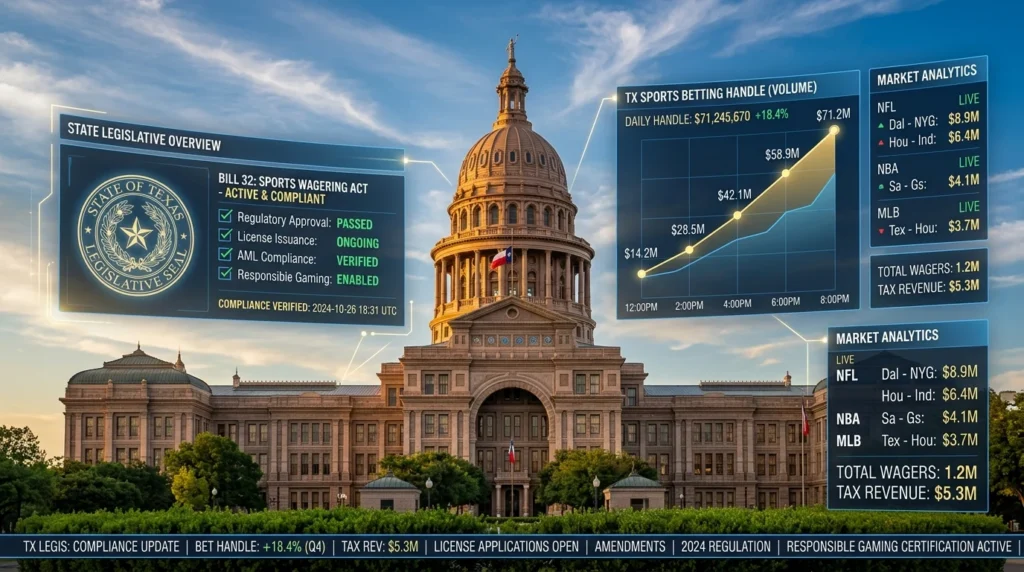
Texas remains the preeminent prize of domestic commercial wagering. With an estimated adult population of 22.4 million and an existing black-market offshore handle evaluated by independent audits at $6.85 billion annually, the state represents an estimated $950 million to $1.25 billion in potential regulated GGR. During the 2025 legislative session, House Joint Resolution 102 passed the House chamber with a 101-42 bipartisan supermajority before stalling in the Senate State Affairs Committee under Lieutenant Governor direction.
Heading into late 2026 interim committee hearings, the legislative architecture has shifted toward an explicit constitutional amendment model requiring a two-thirds majority in both chambers followed by voter ratification. The current draft framework incorporates the following parameters:
- Proposed Statutory Tax Rate: 10.0% on adjusted gross sports betting revenue, with a secondary proposal evaluating a 12.5% rate to fund statewide water infrastructure projects.
- Licensing Allocation: A tethered framework granting skin access to major professional sports franchises (12 available skins) and class-A horse racing tracks (3 available skins), with an initial non-refundable application fee of $500,000 and a 5-year renewal fee of $2,500,000.
- Cross-Border Cannibalization Metrics: Geolocation audit logs from Q1 to Q3 2026 demonstrate that 24.2% of Louisiana mobile wagering handle and 18.6% of Arkansas border handle originate from registered Texas residents traveling across state perimeters on major NFL and college football game days.
The economic cost of inaction has become the primary talking point for legislative proponents. In border metropolitan areas such as Beaumont-Port Arthur and Texarkana, drive-time wagering excursions generate an estimated $182 million in taxable handle across state boundaries per quarter, representing an estimated $18.2 million in foregone direct tax receipts for Texas municipalities per annum.
Minnesota: The Tribal Sovereignty Compromise Model
In Minnesota, legislative negotiations surrounding Senate File 2137 have achieved their most advanced compromise since the Supreme Court invalidated PASPA in 2018. The Minnesota Indian Gaming Association (MIGA), representing all 11 federally recognized tribal nations in the state, has established an exclusive mobile exclusivity posture that blocked previous commercial-first legislative drafts.
The compromise bill under review in late 2026 establishes a hybrid sovereign allocation structure:
| Jurisdiction | Primary Legislative Vehicle | Proposed GGR Tax | Projected Year 1 Handle | License Cap |
|---|---|---|---|---|
| Minnesota | SF 2137 / HF 2000 | 20.0% | $1.85 Billion | 11 Tribal Master Licenses (Up to 22 Skins) |
| Georgia | SR 579 / SB 386 | 22.0% | $2.40 Billion | 16 Untethered & Franchise Licenses |
| Texas | SJR 17 / HB 2025 | 10.0% – 12.5% | $8.45 Billion | 15 Franchise/Track Tethered Skins |
| Missouri (Operational) | Amendment 2 Implementation | 10.0% | $3.10 Billion | 13 Casino + 6 Team Skins |
Under SF 2137, each of the 11 tribes controls an exclusive master wagering license with the option to partner with commercial sportsbook platforms. The key breakthrough involves an annual $14.5 million tax distribution carved out directly to the state’s commercial horse racing tracks (Canterbury Park and Running Aces) to offset historical purse reductions. This arrangement resolved a multi-year litigation threat that had previously halted floor votes.
Georgia: The Constitutional Question vs Lottery Statutory Route
Georgia represents another high-density market currently trapped in procedural debate. The state legislature has repeatedly debated whether sports betting legalization requires a constitutional amendment (requiring a two-thirds majority in both chambers plus a statewide ballot referendum) or can be enacted via simple statutory amendment governing the Georgia Lottery Corporation.
Fiscal modeling submitted to the Georgia Senate Appropriations Committee estimates that a 22.0% tax on adjusted gross revenue would generate $84.2 million in Year 1 state receipts, scaling to $145.8 million by Year 3 at mature market saturation. Proponents have aligned these projected revenues with the HOPE Scholarship program and statewide pre-K education funding, creating substantial public appeal. However, political friction between urban commercial sports coalition advocates and rural conservative delegations regarding casino gaming expansion has continually stalled the companion enabling bill, SB 386.
California: The Post-Prop 26/27 Realignment
Following the catastrophic defeat of Proposition 26 and Proposition 27 in November 2022—which consumed a record $450 million in combined campaign spending—the California market entered an enforced legislative winter. Commercial operators recognized that any future regulatory pathway must be led entirely by the California Nations Indian Gaming Association (CNIGA) and prominent individual tribal gaming leaders.
In late 2026, informal working group sessions indicate that tribal leadership is exploring a sovereign-exclusive, in-person retail framework as an initial step before any consideration of statewide mobile betting. Industry analysts project that a phased rollout will not reach a statewide ballot referendum until the November 2028 election cycle at the earliest. For commercial operators, maintaining compliance goodwill and respecting sovereign jurisdiction boundaries remains paramount, as premature legislative ballot drives have proven counterproductive in California’s unique electoral environment.
Market Implications: Margin Realities and Operator Consolidation
The evolving regulatory climate in late 2026 highlights an undeniable industry trend: the era of low-tax, wide-open commercial expansion in the US is closing. As states observe New York (51.0% tax rate) and Pennsylvania (36.0% tax rate) sustaining multi-billion-dollar annual handles despite steep overheads, legislative bodies are setting baseline tax proposals between 18.0% and 25.0%.
For mid-tier sportsbook operators, these fiscal conditions compound existing customer acquisition costs (CAC), which average $312 per active bettor in established markets. Consequently, market concentration remains intense, with the top two national operators commanding 72.8% of national handle share. Emerging state launches in 2027 and 2028 will favor well-capitalized tier-one books equipped with proprietary technology stacks, superior liquidity management, and optimized risk-pricing engines capable of absorbing statutory margins.
* 18+. Betting involves risk of loss. Some links may be affiliate links; see our affiliate disclosure. Please gamble responsibly.