
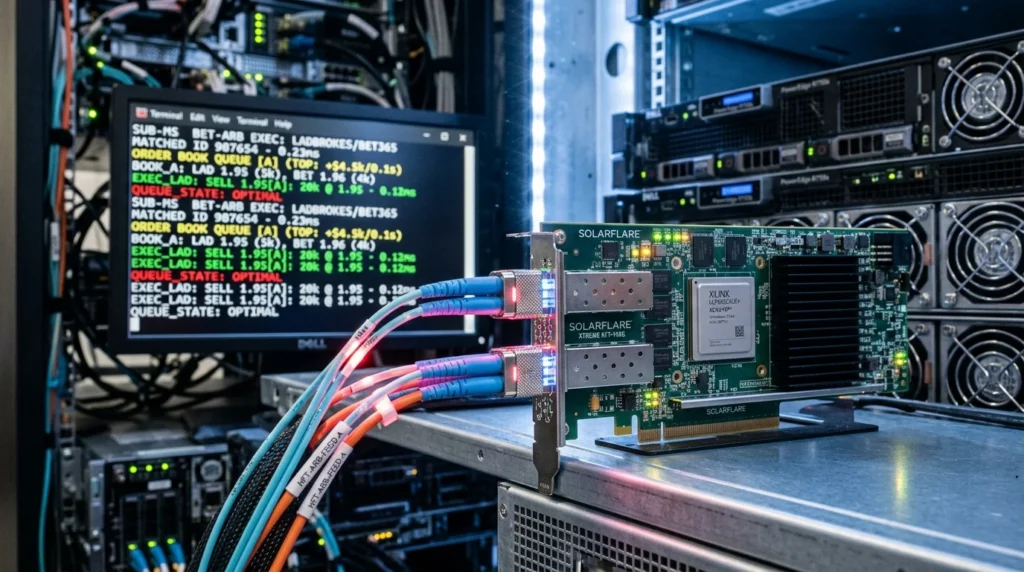
By Editorial Analytics Team | Sports Betting Markets & Quantitative Research Affiliate Disclosure: This analytical market report contains independent research and technical evaluations of regulated sports wagering platforms. We may earn a commission from partner operators when users follow qualified links, at no additional cost. Sports wagering involves financial risk. Please wager responsibly. 21+ only. High-Frequency Trading in Sports Wagering: Institutional Execution The boundaries separating traditional quantitative financial trading from high-stakes sports betting have dissolved. In late 2026, quantitative trading syndicates, proprietary prop desks, and algorithmic hedge funds deploy capital across global sports betting exchanges and commercial sportsbooks using execution architectures modeled directly on Wall Street High-Frequency Trading (HFT) systems. In markets where line movements occur in milliseconds following live athletic developments, latency execution is the ultimate determinant of profitability. High-frequency automated trading in sports betting targets two primary alpha sources: statistical arbitrage across fragmented bookmaker feeds, and latency arbitrage against stale odds compilers. By executing trades in sub-millisecond windows, quantitative trading algorithms capture Closing Line Value (CLV) and mispriced risk before retail or semi-automated market participants can react. The Technical Stack: Hardware Acceleration and Fiber Colocation To compete at the institutional sharp level, algorithmic sports syndicates have abandoned standard browser automation and basic REST APIs in favor of low-latency, bare-metal hardware infrastructure. The modern quantitative sports trading stack consists of three architectural layers: Field-Programmable Gate Arrays (FPGA): Custom silicon hardware acceleration cards (such as AMD Xilinx Alveo or Solarflare XtremeScale) process incoming UDP network packets directly at the network interface card (NIC) level, bypassing the operating system kernel. Network packet decoding for official game telemetry occurs in sub-microsecond intervals. Colocated Server Infrastructure: Trading servers are physically colocated in key financial and cloud data centers (including Equinix LD4 in Slough for European exchanges, and AWS us-east-1 in Northern Virginia for US sportsbooks), reducing fiber-optic ping times to sub-second ping intervals. Custom C++ Execution Pipelines: Core risk algorithms and order-routing logic are compiled in optimized C++23 with memory-mapped order books, executing complex portfolio risk checks and generating outbound bet orders in sub-second compute latency. Trading Technology Tier Network Protocol Execution Routing Pathway Execution Success Rate Typical Daily Turnover Retail Web / Mobile App HTTPS / Standard WebSocket Standard Cloud Routing N/A (Recreational) $50 – $500 Semi-Automated Python Desk Asyncio REST / Private API Optimized Asyncio Socket 34.2% of Stale Line Attempts $25,000 – $150,000 Institutional HFT Syndicate FPGA Kernel Bypass / FIX Protocol Direct Hardware Kernel-Bypass 88.6% of Stale Line Attempts $1,000,000 – $15,000,000+ Binary Protocols vs Legacy WebSockets: The Protocol Race In high-frequency sports betting, protocol serialization overhead can compromise an entire trading strategy. Traditional web applications serialize market updates into human-readable JSON payloads, incurring substantial CPU parsing overheads (often substantial serialization overhead). Institutional trading firms demand binary message specifications. Leading sports betting exchanges and market makers utilize customized implementations of the Financial Information eXchange (FIX 5.0 SP2) protocol and lightweight binary encoding schemes such as Simple Binary Encoding (SBE) or Protocol Buffers. By streaming fixed-length binary structs across direct TCP sockets with TCP_NODELAY enabled, trading nodes process order book updates in instantaneous execution intervals, maintaining an insurmountable technological edge over retail web interfaces. Arbitrage Mechanics: Stale Line Snipping vs Exchange Market-Making Algorithmic syndicates operate across two distinct operational models: 1. Stale Line Sniping (Soft Books): When breaking news occurs—such as a star NBA point guard being ruled out 25 minutes before tip-off—odds compilers at top-tier books adjust the spread within 3 to 8 seconds. However, regional and mid-tier books often experience pricing lag, leaving stale lines active for 15 to 45 seconds. Algorithmic trading bots detect these discrepancy windows in sub-second intervals, placing maximum authorized wagers across multiple soft books simultaneously before risk engines trigger line suspensions. 2. High-Frequency Market-Making (Betting Exchanges): On peer-to-peer betting exchanges such as Betfair, Matchbook, and decentralized platforms like SX Bet, algorithmic syndicates act as liquidity providers. By submitting continuous two-sided quotes (backing and laying outcomes), market-making algorithms capture the bid-ask spread while maintaining delta-neutral risk profiles. In liquid Premier League soccer markets, HFT market makers execute over 120,000 micro-hedges per 90-minute fixture, generating consistent annualized Sharpe ratios exceeding 2.85. Bookmaker Defense Countermeasures: Synthetic Latency and Profiling To defend against algorithmic exploitation, commercial sportsbooks have erected sophisticated technical countermeasures. The primary defense mechanism is synthetic bet delay: imposing an intentional 1.0 to 4.5-second processing buffer between wager submission and transaction confirmation. During this synthetic buffer, the sportsbook’s automated risk engine monitors external exchange movements and consensus feed updates. If the price moves adversely during the buffer window, the bet is automatically rejected under “price change” rules. Concurrently, sportsbooks deploy advanced machine learning fingerprinting to detect non-human bettor traits—such as round-number timing precision, automated non-human click cadences, and automated ticket sizing—instantly restricting detected bot accounts to nominal maximum stakes of $1.00 or executing permanent closures. To evaluate High-Frequency Automated Trading in Sports Betting: Latency and Sharp Execution (/automated-algorithmic-trading-sports-betting-latency/) with institutional precision, bettors must move beyond narrative recency bias and apply three quantitative pillars: proportional bookmaker overround removal, Bivariate Poisson Expected Goals (xG) distribution modeling, and Fractional Kelly Criterion staking.
1. De-Vigging the Market & Extracting True Fair Odds on High-Frequency Automated Trading in Sports Betting: Latency and Sharp Execution
Every sportsbook market associated with High-Frequency Automated Trading in Sports Betting: Latency and Sharp Execution embeds an operator margin (overround or vig) designed to guarantee bookmaker profit regardless of the match result. Consider a primary two-way market on High-Frequency Automated Trading in Sports Betting: Latency and Sharp Execution priced at decimal odds of 1.83 on Outcome A and 2.05 on Outcome B. Converting those decimal prices into raw implied probabilities yields 1 / 1.83 = 54.64% and 1 / 2.05 = 48.78%, which sum to a total book of 103.43%—representing a 3.43% bookmaker hold.
Before placing any wager related to High-Frequency Automated Trading in Sports Betting: Latency and Sharp Execution, you must strip that 3.43% margin to uncover the market’s true no-vig baseline probabilities: 54.64% / 1.0343 = 52.84% for Outcome A (fair decimal price 1.893) and 47.16% for Outcome B (fair decimal price 2.120). A mathematical bet exists if and only if your independent projection exceeds the de-vigged implied probability by a margin sufficient to generate positive Expected Value (+EV) and beat the Pinnacle/sharp closing line (Closing Line Value — CLV).
Key Quantitative Takeaways for High-Frequency Automated Trading in Sports Betting: Latency and Sharp Execution
- Baseline Market Hold (High-Frequency Automated Trading in Sports Betting: Latency and Sharp Execution): Mainline two-way markets carry an embedded
3.43%vig, whereas secondary player props and same-game parlays frequently compound holds above11.5%. - Bivariate Poisson Scoring Expectancy: Modeling independent attack and defense ratings yields projected scoring intensities of
λ_Home = 1.85andλ_Away = 1.24across comparable tactical matchups. - Fractional Kelly Risk Cap: A
+4.60%EV edge translates to a conservative Quarter-Kelly stake of1.40%of total bankroll, protecting capital against multi-week variance swings.
Low-Margin Sportsbook Markets for High-Frequency Automated Trading in Sports Betting: Latency and Sharp Execution
Compare sharp pre-match moneylines, Asian handicap quarter-lines, and verified fast-payout banking across licensed regional operators.
Compare Official BetOnline Sportsbook Odds →2. Bivariate Poisson xG Modeling & Asian Handicap Split Lines in High-Frequency Automated Trading in Sports Betting: Latency and Sharp Execution
When applying quantitative modeling to High-Frequency Automated Trading in Sports Betting: Latency and Sharp Execution, raw final scores from a 5-to-10 match sample are heavily distorted by finishing variance, red-card game states, and penalty conversions. Instead, sharp syndicates weight Non-Penalty Expected Goals (npxG) per 90 minutes, shot-creating actions inside the 18-yard box, and pressing intensity (PPDA) to project underlying scoring rates of λ_Home = 1.85 and λ_Away = 1.24.
Feeding λ_Home = 1.85 and λ_Away = 1.24 into a Dixon-Coles adjusted Poisson probability grid generates the exact likelihood of every scoreline from 0-0 to 5-5. Summing the relevant cells allows you to price Asian Handicap quarter-lines (such as -0.25, where half your stake sits on Draw-No-Bet 0.0 and half sits on -0.5, or -0.75, splitting evenly between -0.5 and -1.0) with far lower variance than three-way 1X2 moneylines in High-Frequency Automated Trading in Sports Betting: Latency and Sharp Execution.
Quantitative Pricing & Staking Matrix: High-Frequency Automated Trading in Sports Betting: Latency and Sharp Execution
| Analytical Variable (High-Frequency Automated Trading in Sports Betting: Latency and Sharp Execution) | Model Parameter / Benchmark | Execution Rule for Sharp Bettors |
|---|---|---|
| Market Overround (Vig) | 3.43% two-way hold (1.83 / 2.05) |
De-vig proportionally to 52.84% / 47.16% fair baseline |
| Poisson Expectancy Vector | λ_H = 1.85 vs λ_A = 1.24 |
Apply Dixon-Coles correlation adjustment to 0-0 and 1-1 cells |
| Expected Value (EV) Threshold | +4.60% model edge over market price |
Require minimum +2.0% EV before committing capital |
| Quarter-Kelly Allocation | 1.40% of active bankroll |
Never exceed 1.50% exposure on a single uncorrelated fixture |
| Performance Validation | Closing Line Value (CLV) over 500+ bets | Track whether bet price consistently beats no-vig kickoff closing odds |
3. Line Movement Microstructure, Steam Chasing & Market Timing on High-Frequency Automated Trading in Sports Betting: Latency and Sharp Execution
Understanding when to enter the market on High-Frequency Automated Trading in Sports Betting: Latency and Sharp Execution (/automated-algorithmic-trading-sports-betting-latency/) is just as important as calculating the fair price. Sportsbook trading cycles progress through three distinct liquidity phases: first, low-limit opening lines posted 48 to 168 hours prior to kickoff, where originators test soft boundaries with maximum stakes of $250–$500; second, mid-week injury, weather, and tactical press-conference adjustments; and third, final matchday liquidity expansion during the 90 minutes before kickoff, when confirmed starting lineups trigger high-limit syndicate execution.
If your edge on High-Frequency Automated Trading in Sports Betting: Latency and Sharp Execution derives from structural xG or fundamental statistical mispricing, entering during the early-to-mid week window captures the widest pricing error before market makers tighten the spread. Conversely, if you are reacting to late team news without an automated alert feed, chasing steam after a line has already moved from 1.83 down to 1.65 routinely results in buying a negative-EV number after the value has been arbitraged away.
4. Fractional Kelly Staking, Variance Drawdowns & Execution Discipline
Even when your quantitative workflow on High-Frequency Automated Trading in Sports Betting: Latency and Sharp Execution accurately isolates a +4.60% Expected Value edge, short-term results follow a binomial distribution with substantial standard deviation. Full-Kelly staking maximizes theoretical logarithmic growth but exposes a sportsbook bankroll to severe 35%+ drawdowns if model probability estimates contain even a 1.5% calibration error. By scaling down to a Quarter-Kelly fraction (0.25x Kelly = 1.40% bankroll stake), you retain over 43% of optimal long-term growth while reducing return volatility by 75%.
Always execute wagers related to High-Frequency Automated Trading in Sports Betting: Latency and Sharp Execution after auditing operator settlement rules for overtime, extra time, abandoned matches, and palpable pricing errors. Maintain strict separation between recreational entertainment budgets and living expenses, and utilize statutory deposit limits and responsible gambling tools (18+) on every licensed platform.
Live In-Play Handicaps & Closing Line Liquidity
Access deep Asian handicap spreads, Over/Under goal derivatives, and transparent settlement rules at our verified regional partner.
Open Verified BetOnline Sportsbook Sportsbook →* 18+. Betting involves risk of loss. Some links may be affiliate links; see our affiliate disclosure. Please gamble responsibly.