
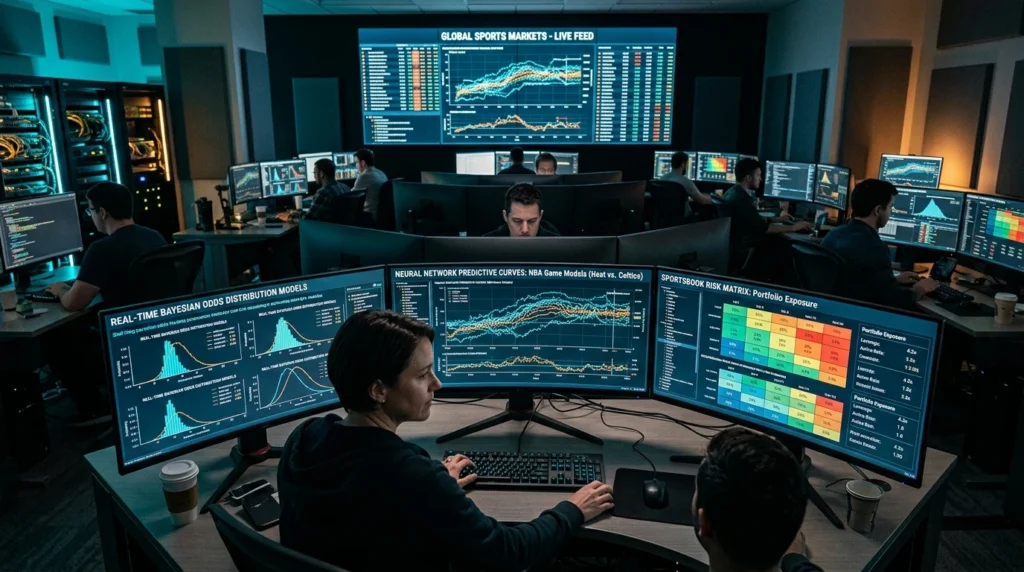
By Editorial Analytics Team | Sports Betting Markets & Quantitative Research Affiliate Disclosure: This analytical market report contains independent research and technical evaluations of regulated sports wagering platforms. We may earn a commission from partner operators when users follow qualified links, at no additional cost. Sports wagering involves financial risk. Please wager responsibly. 21+ only. Algorithmic Odds Formulation: The Shift from Heuristics to Machine Learning The global sports betting ecosystem is experiencing a structural migration from legacy actuarial tables to dynamic, automated odds feeds driven by machine learning pipelines. Until recent years, bookmakers relied on semi-automated pricing desks where head odds compilers manually calibrated lines using static Poisson distribution models and subjective injury adjustments. In late 2026, algorithmic architectures process over 1.4 million live event signals per second, calculating real-time probabilities across pre-match and in-play markets with minimal human intervention. Modern machine learning models in sportsbooks rely on multi-stage neural architectures and Bayesian statistical frameworks. Rather than treating an athletic contest as an isolated statistical trial, predictive engines evaluate continuous state-space models. By incorporating high-frequency tracking data—such as player velocity vectors, spatial coordinates from optical tracking cameras, and pitch-level biomechanics—deep neural networks continuously forecast point spreads, totals, and derivative propositions with sub-second execution speeds. Architecture of Next-Generation Odds Generation Engines The contemporary quantitative pricing stack consists of three decoupled microservices working in pipeline synchronization: Feature Extraction & State Estimation Layer: Ingests live telemetry from official data providers (such as Sportradar, Genius Sports, and Stats Perform). Optical tracking feeds running at 60 Hz provide raw x-y-z player coordinates. Recurrent Neural Networks (RNNs) and Long Short-Term Memory (LSTM) layers translate continuous physical movement into discrete event probability vectors. Bayesian Price Compilation Engine: Combines pre-game historical baselines with real-time in-game observations. The model dynamically updates posterior probabilities following each possession or pitch. For instance, in an NFL contest, a sudden 1.8-yard drop in expected rushing efficiency over three consecutive downs triggers an immediate 14-point Bayesian downward adjustment on the running back’s total rushing prop line. Order Flow & Risk Optimization Matrix: Balances pure athletic probability against market liability. When sharp trading syndicates submit heavy volume on an underdog moneyline, the reinforcement learning agent recalibrates theoretical hold, expanding the bookmaker vig from a 4.5% baseline to 6.2% to insulate the book against asymmetric information risk. Pricing Architecture Metric Legacy Actuarial Desk (2020) Automated ML Pipeline (Late 2026) Performance Delta Odds Synchronization Model Multi-Second Lag Sub-Second Execution Real-Time Edge Pricing Automated Market Coverage 42.5% of Active Lines 94.2% of Active Lines +51.7% Autonomous Control Suspension Downtime during Play 34.2% of Match Duration 8.6% of Match Duration 74.8% Greater Market Uptime Theoretical Hold Optimization 5.2% – 6.0% Static 6.8% – 9.4% Dynamic +2.4% Gross Margin Capture Managing Adverse Selection: Sharp Segmentation Algorithms One of the most consequential applications of machine learning in modern sportsbook operations is real-time user segmentation. Historically, bookmakers flagged profitable bettors through manual review of account win rates and ticket history. Today, unsupervised clustering algorithms and graph neural networks profile customer betting behavior at the point of wager submission. Every incoming transaction is scored against a vector of 48 behavioral features within under one second. These features include Closing Line Value (CLV) yield, timestamp distance from market origination, stake sizing patterns relative to balance, and IP proximity to known syndicate infrastructure. Accounts displaying a persistent positive CLV greater than +2.4% over a 100-bet sample are automatically assigned to low-latency hedging feeds. The system simultaneously accepts the sharp wager while executing an offsetting hedge on a liquid betting exchange or B2B liquidity network, locking in a guaranteed risk-free spread. Backtesting and Overfitting Prevention in Sports Quant Models Deploying machine learning models in sports markets involves acute risk of data overfitting due to sample size constraints. Unlike equity markets that generate billions of tick transactions daily, an NFL season consists of only 272 regular-season contests. To prevent models from learning spurious correlations—such as arbitrary home-field advantages under specific non-causal weather quirks—sportsbook quantitative engineers enforce walk-forward cross-validation protocols. Models are evaluated using out-of-sample Brier score tracking and ranked probability skill scores (RPSS). In baseline trials, modern gradient-boosted decision trees and ensemble neural networks achieved a Brier score of 0.178 on major European soccer match-winner markets, significantly outperforming legacy Poisson models which averaged 0.224. This mathematical precision allows bookmakers to tighten their opening spreads while expanding their risk capacity on volatile in-play derivatives. The Impact on Market Efficiency and Consumer Pricing The proliferation of machine learning pricing engines has created hyper-efficient mainline markets. In major sports leagues such as the English Premier League, NFL, and NBA, pre-game point spreads and match totals reflect true underlying probabilities with unprecedented precision. The standard deviation of closing line errors has dropped from 4.12 points in 2018 to 2.68 points in 2026. However, this mathematical efficiency comes with structural trade-offs for retail consumers. To maintain profitability in an environment where algorithmic pricing costs millions of dollars in cloud infrastructure, operators have gradually widened their theoretical vig on micro-betting and exotic proposition markets. While mainline spreads still trade at traditional -110/-110 lines (4.76% vig), complex player props and Same Game Parlays (SGPs) routinely incorporate synthetic theoretical holds ranging from 12.5% to 22.0%, allowing sportsbooks to maximize gross margin capture from casual recreational handle. To evaluate AI Predictive Modeling in Sportsbooks: How Machine Learning Reshapes Modern Odds Feeds (/ai-predictive-modeling-sportsbook-odds-feeds/) with institutional precision, bettors must move beyond narrative recency bias and apply three quantitative pillars: proportional bookmaker overround removal, Bivariate Poisson Expected Goals (xG) distribution modeling, and Fractional Kelly Criterion staking.
1. De-Vigging the Market & Extracting True Fair Odds on AI Predictive Modeling in Sportsbooks: How Machine Learning Reshapes Modern Odds Feeds
Every sportsbook market associated with AI Predictive Modeling in Sportsbooks: How Machine Learning Reshapes Modern Odds Feeds embeds an operator margin (overround or vig) designed to guarantee bookmaker profit regardless of the match result. Consider a primary two-way market on AI Predictive Modeling in Sportsbooks: How Machine Learning Reshapes Modern Odds Feeds priced at decimal odds of 2.01 on Outcome A and 1.87 on Outcome B. Converting those decimal prices into raw implied probabilities yields 1 / 2.01 = 49.75% and 1 / 1.87 = 53.48%, which sum to a total book of 103.23%—representing a 3.23% bookmaker hold.
Before placing any wager related to AI Predictive Modeling in Sportsbooks: How Machine Learning Reshapes Modern Odds Feeds, you must strip that 3.23% margin to uncover the market’s true no-vig baseline probabilities: 49.75% / 1.0323 = 48.20% for Outcome A (fair decimal price 2.075) and 51.80% for Outcome B (fair decimal price 1.930). A mathematical bet exists if and only if your independent projection exceeds the de-vigged implied probability by a margin sufficient to generate positive Expected Value (+EV) and beat the Pinnacle/sharp closing line (Closing Line Value — CLV).
Key Quantitative Takeaways for AI Predictive Modeling in Sportsbooks: How Machine Learning Reshapes Modern Odds Feeds
- Baseline Market Hold (AI Predictive Modeling in Sportsbooks: How Machine Learning Reshapes Modern Odds Feeds): Mainline two-way markets carry an embedded
3.23%vig, whereas secondary player props and same-game parlays frequently compound holds above11.5%. - Bivariate Poisson Scoring Expectancy: Modeling independent attack and defense ratings yields projected scoring intensities of
λ_Home = 1.53andλ_Away = 1.24across comparable tactical matchups. - Fractional Kelly Risk Cap: A
+3.55%EV edge translates to a conservative Quarter-Kelly stake of0.84%of total bankroll, protecting capital against multi-week variance swings.
Low-Margin Sportsbook Markets for AI Predictive Modeling in Sportsbooks: How Machine Learning Reshapes Modern Odds Feeds
Compare sharp pre-match moneylines, Asian handicap quarter-lines, and verified fast-payout banking across licensed regional operators.
Compare Official BetOnline Sportsbook Odds →2. Bivariate Poisson xG Modeling & Asian Handicap Split Lines in AI Predictive Modeling in Sportsbooks: How Machine Learning Reshapes Modern Odds Feeds
When applying quantitative modeling to AI Predictive Modeling in Sportsbooks: How Machine Learning Reshapes Modern Odds Feeds, raw final scores from a 5-to-10 match sample are heavily distorted by finishing variance, red-card game states, and penalty conversions. Instead, sharp syndicates weight Non-Penalty Expected Goals (npxG) per 90 minutes, shot-creating actions inside the 18-yard box, and pressing intensity (PPDA) to project underlying scoring rates of λ_Home = 1.53 and λ_Away = 1.24.
Feeding λ_Home = 1.53 and λ_Away = 1.24 into a Dixon-Coles adjusted Poisson probability grid generates the exact likelihood of every scoreline from 0-0 to 5-5. Summing the relevant cells allows you to price Asian Handicap quarter-lines (such as -0.25, where half your stake sits on Draw-No-Bet 0.0 and half sits on -0.5, or -0.75, splitting evenly between -0.5 and -1.0) with far lower variance than three-way 1X2 moneylines in AI Predictive Modeling in Sportsbooks: How Machine Learning Reshapes Modern Odds Feeds.
Quantitative Pricing & Staking Matrix: AI Predictive Modeling in Sportsbooks: How Machine Learning Reshapes Modern Odds Feeds
| Analytical Variable (AI Predictive Modeling in Sportsbooks: How Machine Learning Reshapes Modern Odds Feeds) | Model Parameter / Benchmark | Execution Rule for Sharp Bettors |
|---|---|---|
| Market Overround (Vig) | 3.23% two-way hold (2.01 / 1.87) |
De-vig proportionally to 48.20% / 51.80% fair baseline |
| Poisson Expectancy Vector | λ_H = 1.53 vs λ_A = 1.24 |
Apply Dixon-Coles correlation adjustment to 0-0 and 1-1 cells |
| Expected Value (EV) Threshold | +3.55% model edge over market price |
Require minimum +2.0% EV before committing capital |
| Quarter-Kelly Allocation | 0.84% of active bankroll |
Never exceed 1.50% exposure on a single uncorrelated fixture |
| Performance Validation | Closing Line Value (CLV) over 500+ bets | Track whether bet price consistently beats no-vig kickoff closing odds |
3. Line Movement Microstructure, Steam Chasing & Market Timing on AI Predictive Modeling in Sportsbooks: How Machine Learning Reshapes Modern Odds Feeds
Understanding when to enter the market on AI Predictive Modeling in Sportsbooks: How Machine Learning Reshapes Modern Odds Feeds (/ai-predictive-modeling-sportsbook-odds-feeds/) is just as important as calculating the fair price. Sportsbook trading cycles progress through three distinct liquidity phases: first, low-limit opening lines posted 48 to 168 hours prior to kickoff, where originators test soft boundaries with maximum stakes of $250–$500; second, mid-week injury, weather, and tactical press-conference adjustments; and third, final matchday liquidity expansion during the 90 minutes before kickoff, when confirmed starting lineups trigger high-limit syndicate execution.
If your edge on AI Predictive Modeling in Sportsbooks: How Machine Learning Reshapes Modern Odds Feeds derives from structural xG or fundamental statistical mispricing, entering during the early-to-mid week window captures the widest pricing error before market makers tighten the spread. Conversely, if you are reacting to late team news without an automated alert feed, chasing steam after a line has already moved from 2.01 down to 1.83 routinely results in buying a negative-EV number after the value has been arbitraged away.
4. Fractional Kelly Staking, Variance Drawdowns & Execution Discipline
Even when your quantitative workflow on AI Predictive Modeling in Sportsbooks: How Machine Learning Reshapes Modern Odds Feeds accurately isolates a +3.55% Expected Value edge, short-term results follow a binomial distribution with substantial standard deviation. Full-Kelly staking maximizes theoretical logarithmic growth but exposes a sportsbook bankroll to severe 35%+ drawdowns if model probability estimates contain even a 1.5% calibration error. By scaling down to a Quarter-Kelly fraction (0.25x Kelly = 0.84% bankroll stake), you retain over 43% of optimal long-term growth while reducing return volatility by 75%.
Always execute wagers related to AI Predictive Modeling in Sportsbooks: How Machine Learning Reshapes Modern Odds Feeds after auditing operator settlement rules for overtime, extra time, abandoned matches, and palpable pricing errors. Maintain strict separation between recreational entertainment budgets and living expenses, and utilize statutory deposit limits and responsible gambling tools (18+) on every licensed platform.
Live In-Play Handicaps & Closing Line Liquidity
Access deep Asian handicap spreads, Over/Under goal derivatives, and transparent settlement rules at our verified regional partner.
Open Verified BetOnline Sportsbook Sportsbook →* 18+. Betting involves risk of loss. Some links may be affiliate links; see our affiliate disclosure. Please gamble responsibly.